The Architecture of Attention: Why Brands Need the Hero's Journey Framework
Cut through AI noise with the Hero’s Journey. Make the customer the hero, position your brand as guide, and use GenAI + StoryBrand to scale content.

We've all seen the data: 90% of content is ignored. In an era where GenAI can produce a thousand blog posts in a minute, the problem isn't a lack of information, it's a lack of meaning and relevance for the audience.
If you've ever wondered why some brands cut through noise effortlessly while others shout into the void, the answer isn't louder volume or better distribution. It's structure. Human brains are hardwired to process information through a specific narrative arc that has existed for thousands of years: The Hero's Journey. In this article, I'll show you how to apply this framework to every piece of content you create – from a 280-character tweet to a 20-page whitepaper – and how GenAI can scale your storytelling without diluting the emotional core that makes stories work.
Why Most Content Fails: The Storytelling Misconception
Many marketers think "storytelling" means adding a few adjectives to a product description or inserting a customer quote at the end of a case study. It isn't. Storytelling is a biological hack, a way of organizing information that matches how the human brain evolved to process, remember, and emotionally respond to patterns.
When you tell someone "Our platform increased productivity by 40%", their brain files it as a data point. When you tell them "Sarah was drowning in spreadsheets until she found our platform, and now she leaves work at 5pm every day", their brain files it as a lived experience, even though they've never met Sarah.
That's the power of narrative structure. And the most reliable structure – tested across every culture, every era, every medium – is the Hero's Journey.
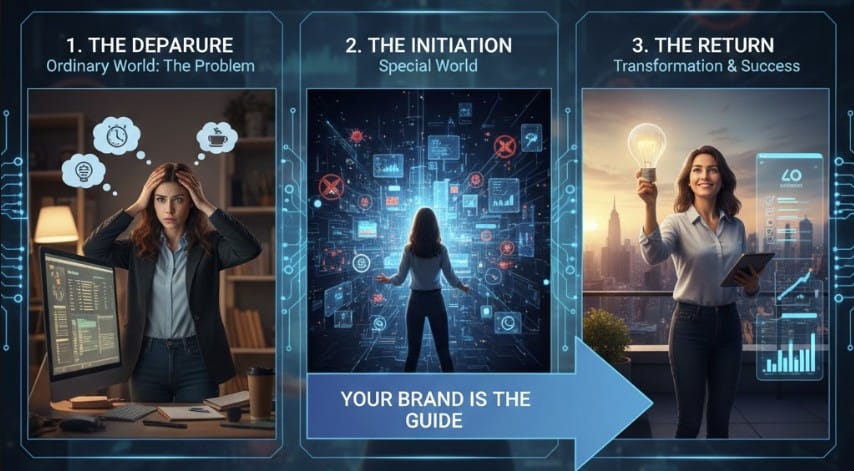
The Hero's Journey Framework: A 3-Act Structure for Brand Content
The Hero's Journey, popularized by Joseph Campbell and adapted by countless screenwriters, novelists, and marketers, is the zoom-in on the human experience within your market. It organizes the chaos of a customer's life into a meaningful, predictable arc.
Act 1: The Departure
The Customer (the Hero) is in their "Ordinary World" , their current reality. But they face a problem they cannot solve alone. This creates tension, discomfort, or desire for change.
Act 2: The Initiation
The Customer enters the "Special World" (the market) where they encounter challenges, competing solutions, and obstacles. They need guidance.
Act 3: The Return
The Customer uses your solution (the tool given by the Guide) to overcome the problem and returns to their life transformed - with a sense of relief, control, or achievement.
This structure isn't just for screenplays. It's how every successful brand message works – from Nike's "Just Do It" campaigns to Apple's product launches. The customer is always the protagonist. The brand is always the mentor.

The Critical Choice: Who Is the Hero of Your Story?
The most critical decision in your narrative strategy is deciding who gets the spotlight. Most marketing fails because it defaults to the brand-centric approach, where the company tries to be the star. To truly connect, you must shift to the customer-centric approach.
Brand-Centric Approach ( Wrong) Wrong) | Customer-Centric Approach ( Right) Right) |
|---|---|
| The Brand is the Hero: Focus on our history, awards, features. | The Customer is the Hero: Focus on their journey, struggle, and ultimate success. |
| "We are the best": Messaging is boastful and self-important. | "You can do this": Messaging is empathetic and authoritative. |
| The Brand saves the day: We position ourselves as the protagonist. | The Brand provides the tools: We are the mentor who gives the Hero the plan to win. |
The Rule: A story with two heroes is a story with no hero. Our job is to make the customer look successful, not our brand.
Brand-as-Guide: The Positioning That Actually Converts
In every great story, the Hero meets a Guide, a character who has walked the path before, understands the struggle, and provides the tools, wisdom, or plan to help the Hero win. Think Obi-Wan Kenobi. Think Mr. Miyagi. Think every great mentor in fiction.
Your brand must occupy that role. Not the Hero. The Guide.
What does a Guide do in practice?
- Shows empathy: "We understand you're overwhelmed by X."
- Demonstrates authority: "We've helped 500+ companies solve X."
- Provides a plan: "Here's the 3-step process."
- Calls to action: "Start your free trial today."
- Paints the success vision: "Imagine finishing work at 5pm every day."
Notice what the Guide doesn't do: brag about features, dominate the spotlight, or make the story about themselves.
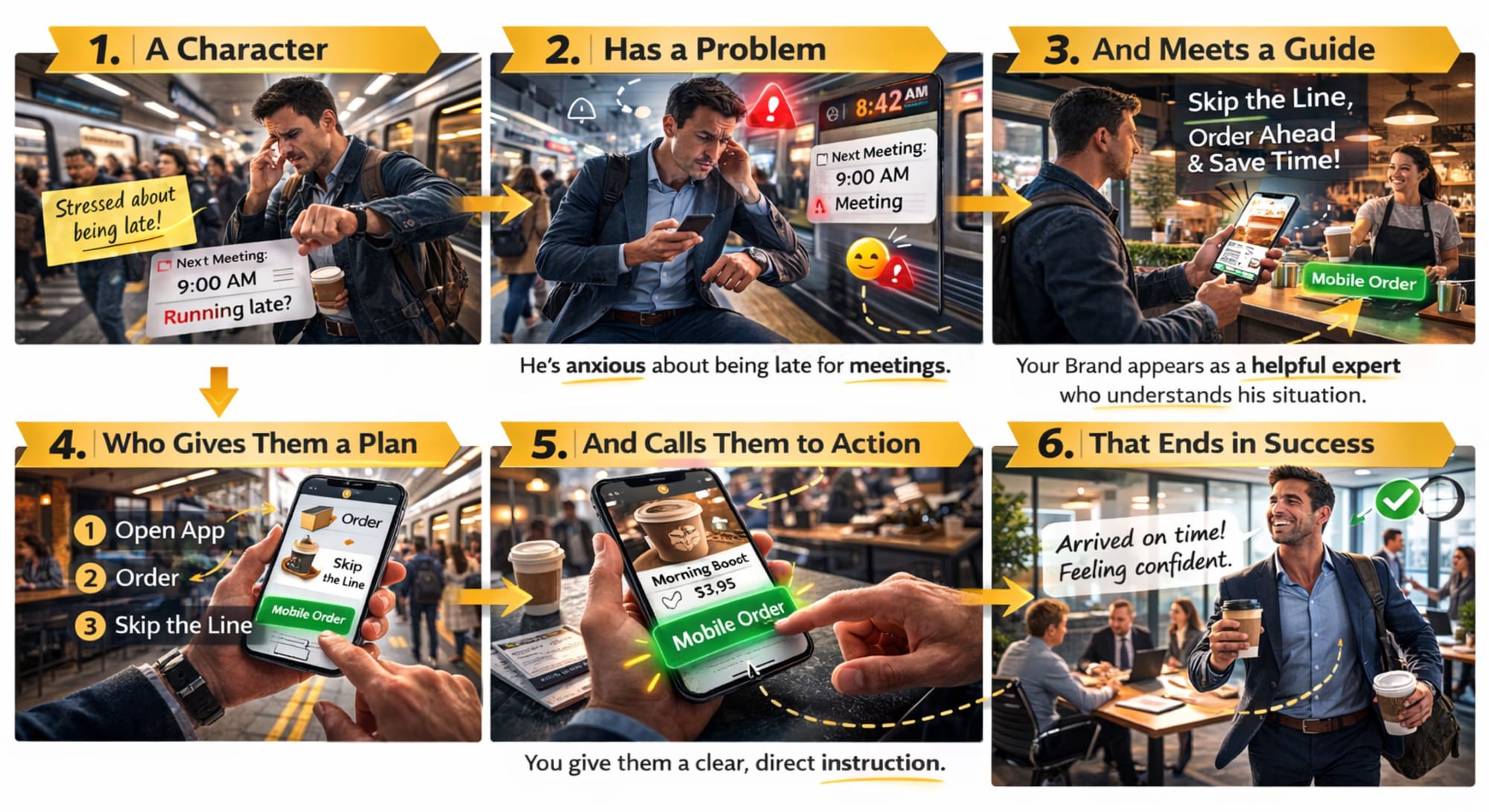
The StoryBrand Script: Operationalizing the Hero's Journey
Donald Miller's StoryBrand framework (based directly on the Hero's Journey) gives us a practical 7-part script to apply narrative structure to brand messaging. This ensures your content stays focused on the customer's transformation rather than your company's features.
- A Character: This is your Buyer Persona (e.g., Commuter Chris from our previous article).
- Has a Problem: They are struggling with a specific pain point (e.g., Chris is anxious about being late for meetings).
- And Meets a Guide: Your Brand appears as a helpful expert who understands their situation.
- Who Gives Them a Plan: You provide 3 simple steps to solve the problem (e.g., 1. Open App, 2. Order, 3. Skip the line).
- And Calls Them to Action: You give them a clear, direct instruction (e.g., a "Mobile Order" button).
- That Ends in Success: You describe the "Happy Ending" where the Hero/Customer wins (e.g., Chris arrives at his meeting on time, feeling confident).
- (Optional) And Helps Them Avoid Failure: You hint at what happens if they don't act (e.g., "Stop missing important moments.").
This script works for landing pages, email sequences, pitch decks, social posts, case studies, and sales calls. Any time you communicate with a customer, this structure ensures clarity and emotional resonance.
Before and After: Brand-Centric vs. Customer-Centric Messaging
Brand-Centric (Before)
"We are the leading productivity platform with 20 years of experience, award-winning design, and cutting-edge AI features trusted by Fortune 500 companies."
Why it fails: The brand is the hero. The customer is passive. No problem is acknowledged. No transformation promised.
Customer-Centric (After)
"You're drowning in spreadsheets and back-to-back meetings. We've helped 500+ teams reclaim their time with a simple 3-step system. Start your free trial and leave work at 5pm today."
Why it works: Customer is the hero. Problem is named. Guide offers a plan. Clear action. Success vision painted.
Common Mistakes When Applying the Hero's Journey
Mistake #1: Making the brand the hero
If your homepage says "We revolutionized the industry" before it says "You deserve better tools," you've lost the plot. The customer should see themselves in Act 1 of the story before they see your brand in Act 2.
Mistake #2: Skipping the problem
Many brands jump straight to "Here's our amazing solution!" without establishing what problem the Hero is facing. If the audience doesn't recognize their struggle in your message, they won't care about your solution.
Mistake #3: Overcomplicating the plan
The Guide's role is to simplify. If your "plan" has 12 steps, it's not a plan, it's a manual. Distill it to 3 clear actions. That's what the brain can hold and act on.
Mistake #4: Forgetting the success vision
People don't buy features. They buy the feeling of the transformation. Always paint the "after" picture – what does life look like when the problem is solved?
How to Use GenAI to Scale the Hero's Journey
Once you've defined your Brand's Hero's Journey – your customer persona, their problem, your role as Guide, and the transformation you enable – you can use GenAI to ensure every piece of content sticks to this arc.
The Strategy: Don't ask GenAI to "write a story". Ask it to "map this product launch to the Hero's Journey while keeping the brand-as-guide."
Here's the prompt template I use:
You are a Storytelling Consultant specializing in the Hero's Journey framework and StoryBrand methodology.
Context:
- Our Customer (the Hero) is: [Persona name, role, main problem]
- Our Brand (the Guide) is: [Brand name, what we do, our authority]
- The Transformation we enable: [Before state → After state]
Task: Rewrite the following content using the StoryBrand 7-part script:
1. A Character (identify the Hero explicitly)
2. Has a Problem (name it clearly)
3. Meets a Guide (introduce our brand as mentor)
4. Who Gives Them a Plan (3 simple steps)
5. And Calls Them to Action (one clear CTA)
6. That Ends in Success (paint the victory)
7. And Helps Them Avoid Failure (optional: hint at the stakes)
Content to rewrite: [Paste your draft here]
This prompt transforms GenAI from a generic content generator into a narrative consultant who knows your framework and enforces it across every asset.
The Narrative Stress-Test: A Practical Exercise
Want to audit your existing content? Use this exercise:
Step 1: The Setup
Identify a piece of content (a landing page, email, or case study) where the brand feels like it's "bragging."
Step 2: The Prompt
Act as a Storytelling Consultant specializing in the Hero's Journey.
Task: Audit the following text to ensure the Customer is the Hero and the Brand is the Guide.
1. Identify the Hero: Who is the main character? If it's the brand, highlight what needs to change.
2. Identify the Guide: Does the brand sound like a helpful mentor or a boastful protagonist?
3. The Pivot: Rewrite the text so the Customer's problem is the starting point and the Brand's solution is the 'tool' for their victory.
Content: [Paste here]
Step 3: Validate the result
Use your own expertise and judgment to make sure the final output is correct. When in doubt, edit the draft using your marketing expert lens.
Why This Framework Works in the Age of AI
GenAI can write 1,000 blog posts in an hour. But it can't make people care. That's a human skill, and it requires structure, empathy, and narrative discipline.
The Hero's Journey is the antidote to AI-generated noise because it forces you to ask the right questions:
- Who is this for? (The Hero)
- What are they struggling with? (The Problem)
- How do we help them win? (The Plan)
- What does victory look like? (The Transformation)
When you answer those four questions clearly, every piece of content you create - whether written by a human or assisted by AI - will have emotional weight, structural clarity, and conversion power.
Final Thought
Information tells, but stories sell. In a world of infinite AI-generated noise, the only thing that will make your brand memorable is a narrative that makes your customer feel like they are on a journey toward something better.
Are you using the storytelling framework with a customer-centric approach or just describing your company and your products?
Recommended Use Cases:
 Diana Socaciu